|
Pictures of The Universe:
|
|
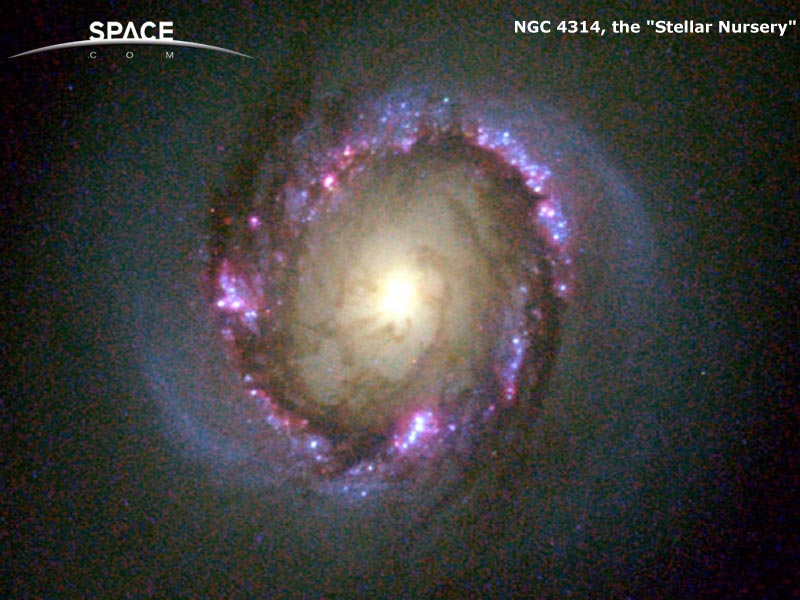
This Picture above, represents some Clusters of infant stars which forms a ring around the core of this stellar nursery which is a barred-spiral galaxy.
|
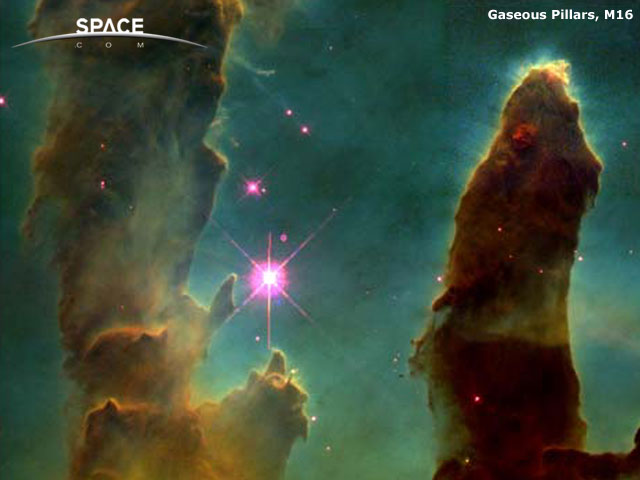
This picture above represents The Eagle Nebula (M16) is a nearby star-forming.
|
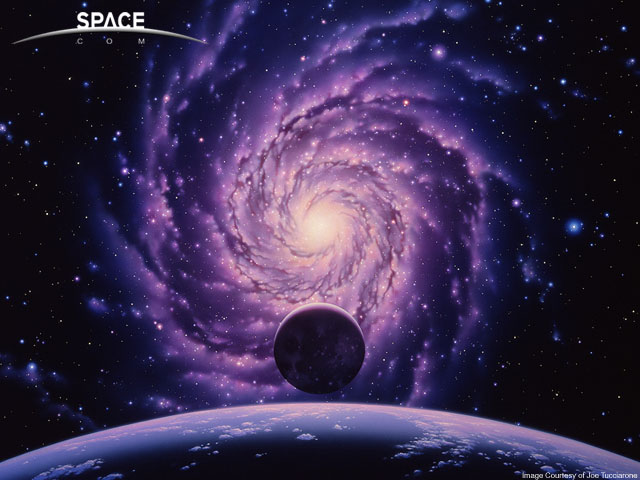
This Picture above represents our Milky Way Galaxy.
|
|

This picture above was taken in one of the moons of the Planet Saturn. This moon is known as Titan and is the biggest moon in Saturn. It represents the lake inside the moon.
|
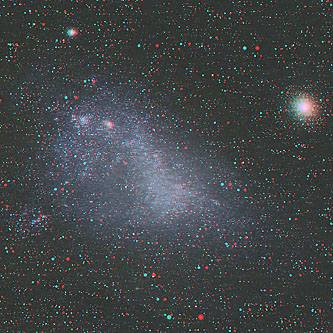
This Image above, represents a Small Magellanic Cloud.
|
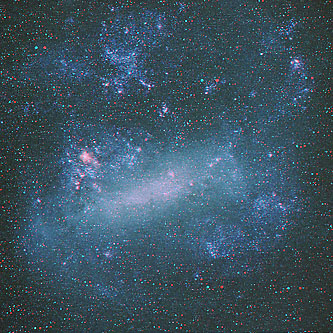
This image above, represents a Large Magellanic Cloud.
|
|
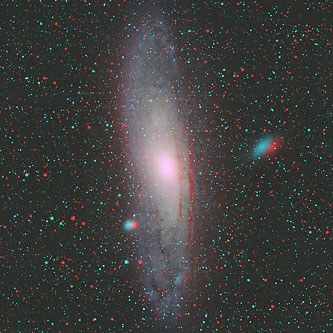
This picture above represents The Andromeda Great Galaxy. This image above represents, a Galaxy that is very, very far away from our Galaxy.
|
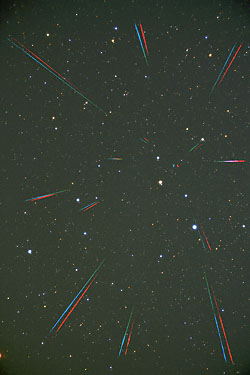
This image above represents some of the shooting stars known as Leonids, which were pictured in Japan in 2001.
|
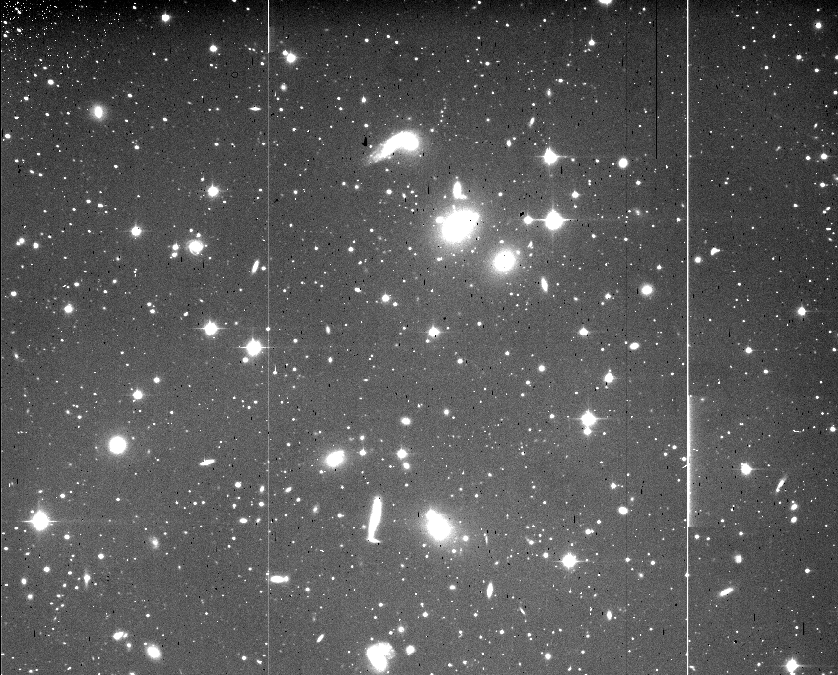
This picture above, represents a 2048x2048 image of the Hercules cluster. This cluster has a recessional velocity of 11,000 km/s. It contains a number of spiral galaxies, many of which are intereacting. This is a sure sign that the cluster still has substructure and is not fully virialized yet.
|
|
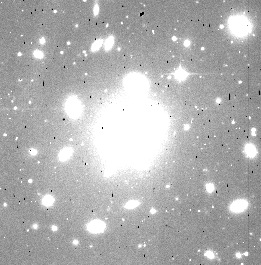
This image above, represents a 2048x2048 image of the Coma Cluster. This cluster has a recessional velocity of 7000 km/s and is the densest cluster in our local region of the Universe. In contrast to the Hercules cluster, Coma has almost no spiral galaxies in its central regions. The cluster is strongly viralized and has a hot intracluster medium which generates strong X-Ray emission. This image shows the central few 100 kpc of the Coma Cluster. At a slightly larger radius, images reveal that Coma is still rather devoid of spiral galaxies. It is generally believed that the cold hydrogen gas in the disks of spiral galaxies is swept out of them as they orbit through the intracluster medium of Coma.
|
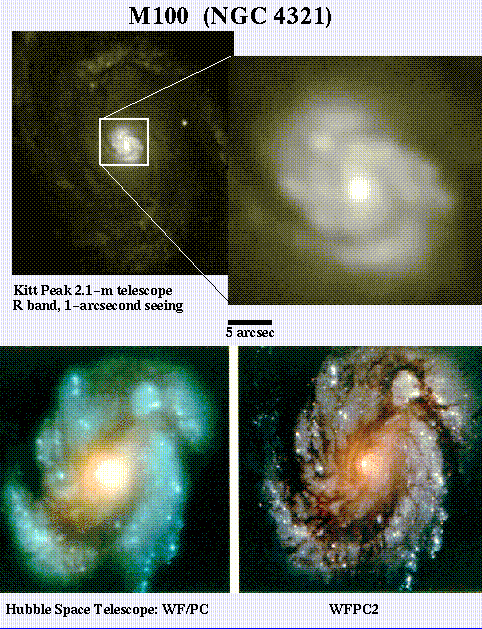
This image above represents this montage, which compares ground-based and HST (before and after the December 1993 servicing mission) views of the spiral galaxy M100 = NGC 4321 in the Virgo cluster. The upper panels show an R-band CCD image taken from Kitt Peak in reasonably good seeing conditions (image FWHM near 1 arcsecond). The inset indicates (except for a rotation) the region shown in the lower set of early-release Space Telescope pictures (themselves nabbed from stsci.edu). The structure of the inner part of this galaxy is almost completely lost in the ground-based picture.
|
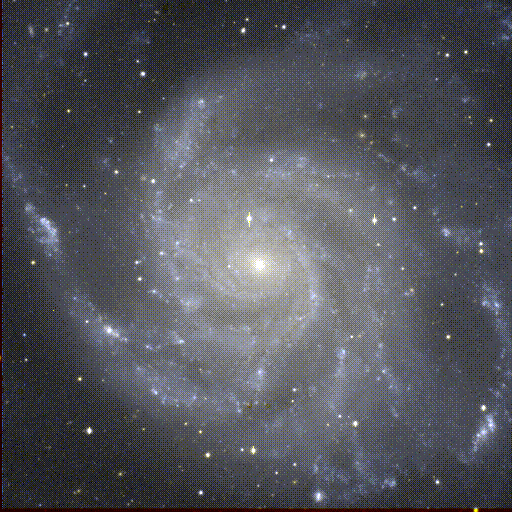
This image represents the nearby Sc spiral (in fact, perhaps the textbook example of a luminous so-called luminosity class I spiral) NGC 5457 or Messier 101. It has several extremely luminous star-forming (H II) regions in the outer spiral arms, some sporting their own NGC numbers. It dominates a small group of galaxies, with some of its neighbors such as NGC 5474 showing wear and tear attributed to the tidal effects of M101. M101 itself is further noteworthy for its extensive and lopsided distrubution of neutral hydrogen gas, and for showing evidence of gas falling into its disk at high speeds. Cepheid variables suggest a distance of about 7 Megaparsecs (about 22 million light-years); at that distance some can just be picked up from the ground when the seeing cooperates, though the definitive study had to await the availability of HST.
|
|
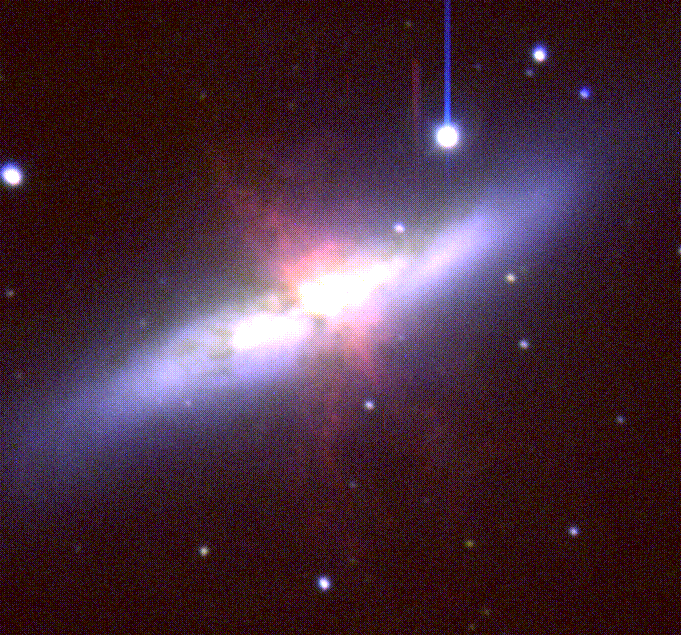
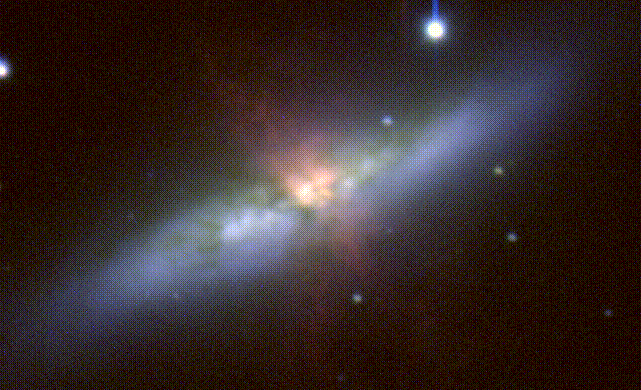
This first image is nearby interacting starburst galaxy Messier 82 (NGC 3034), in a slightly odd color-composite CCD image. Here, the red filter was a narrow-band one that passed H-alpha emission from the galaxy, highlighting the outflow of ionized gas driven by the starburst which has raged through much of M82 but most strongly in the central regions. More detail of the dust in M82's disk is shown in a slower-contrast image highlighting the inner regions.
|
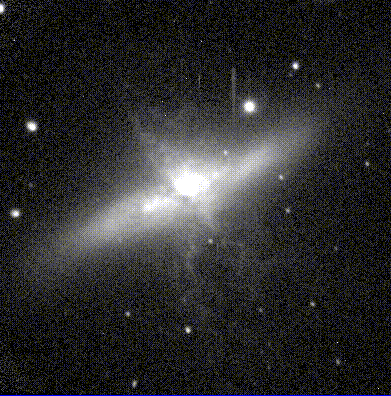
This image is monochrome rendering of the narrowband image including H-alpha.
|
Here in this image, we can see some of the dust which keeps us from seeing the very nucleus in visible light (though it's quite exciting when seen in the deep infrared or radio bands). M82 is interacting with M81, with a huge connecting envelope of neutral hydrogen; this interaction, with NGC 3077 as a co-cospirator, is also very likely responsible for triggering the beautiful grand-design spiral pattern that makes M81 such a favorite.
|
|
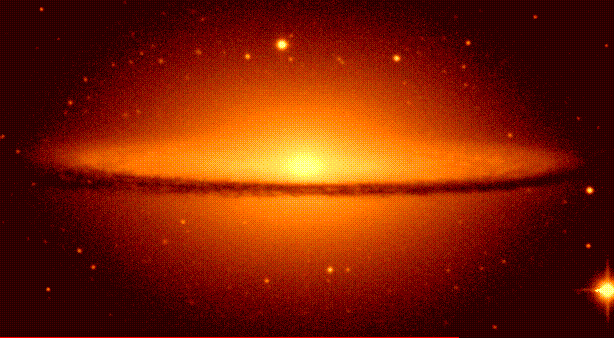
This picture represents the well-known "Sombrero" galaxy M104 (NGC 4594) in Virgo. This is an excellent example of the early-type Sa spirals, with tightly-wound spiral arms (in fact, they can be difficult to trace when seen this close to edge-on) and a large-luminous bulge. The dense dust lane in this disk gives the galaxy its common name. M104 has a mildly active nucleus, seen in emission lines and radio emission, and has been discussed as a cnadidate for hosting a supermassive black hole, based on stellar dynamics in its core. This image is from a blue-light exposure with the 0.9-meter telescope of Kitt Peak National Observatory, with the data provided courtesy of T. Boroson.
|
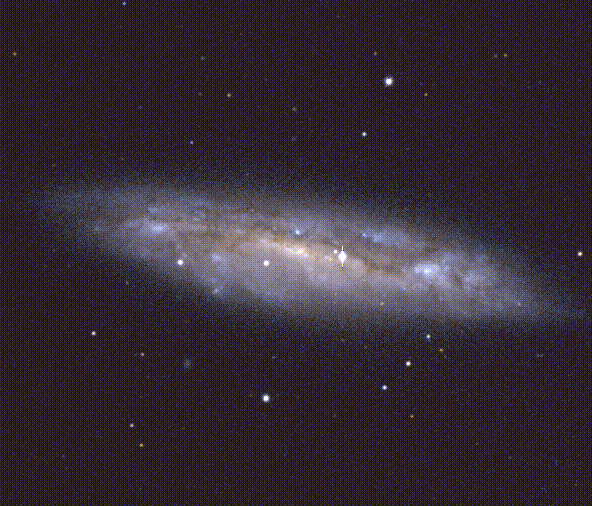
This above image represents color-composite CCD image shows the bright late-type spiral galaxy M108 (NGC 3556) in Ursa Major. This galaxy shows an especially good example of dust structure with substantial thickness in the galaxy disk; even though it is several degrees from edge-on, substantial dust shows up in front of the nuclear bulge. M108 is easy to find telescopically, just outside the bowl of the Big Dipper close to Beta Ursae Majoris. It shows up in the same low-power field as the Owl Nebula (M97).
|
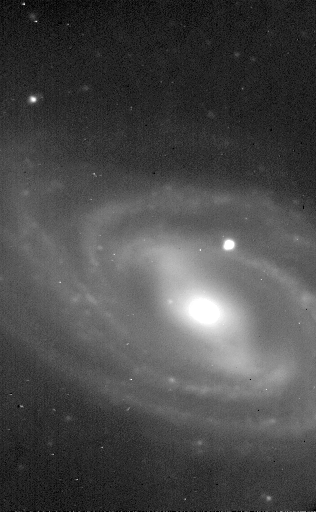
This above image represents the bright spiral galaxy Messier 109 (NGC 3992) in Ursa Major, shown from a yellow-light (V-band) CCD exposure with an RCA CCD at the 1.1-meter Hall telescope of Lowell Observatory. North is at the top and east to the left, for direct comparison with a chart or eyepiece view. This display uses a logarithmic intensity transformation to preserve information across a wide dynamic range. The field is 3.6 by 6.0 arcminutes, which doesn't cover the whole galaxy (the bigger TI CCDs had gone to Australia at the time, to support observations of the Shoemaker-Levy 9 impact). The image was obtained in April 1994 by Bill Keel and Anatoly Zasov.
|
|

This picture above was pictured on Wednesday, April 4, 2001. Before fading beyond the far side of the sun, one of the most turbulent sunspots in a decade spawned the biggest solar flare on record. Meanwhile, another large area of disturbance has emerged, one that could push more powerful solar salvos toward Earth. On Monday, a sunspot called active region 9393 by scientists unleashed a major solar flare at 5:51 p.m. EDT. The flare is the biggest on record, according to researchers with the Solar and Heliospheric Observatory, one of a fleet of spacecraft monitoring solar activity and its effects on the Earth. The blast was even larger than a 1989 solar flare that led to the collapse of a major power grid in Canada. Radiation from the new flare was so intense it saturated the X-ray detectors on two spacecraft used by the U.S. government to determine the strength of the solar blasts. Monday's flare also was the most powerful recorded since regular X-ray data became available in 1976. But it did not head directly toward Earth, sparing sensitive electrical and communications systems, space scientists said. Sunspot 9393 should drift out of view within a day as the sun rotates. But active region 9415, another large sunspot emerging on the visible side of the sun, could hurl destructive solar storms our way. The new spot already produced a powerful type of solar burst on Monday. The sun, at the peak of an 11-year cycle of activity, has become increasingly active in recent weeks. At such times the star is often rife with sunspots, relatively cool and dark regions on the surface caused by a concentration of temporarily distorted magnetic fields.
|
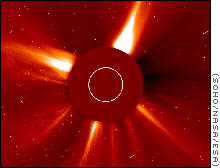
This Image above, is known is Coronal Mass ejection, which was recorded on Wednesday, April 4, 2001. Sunspots spawn tremendous eruptions into the atmosphere, known as coronal mass ejections (CMEs), which hurl billions of tons of electrified gas and radiation into space. Directed toward Earth, such storms can disrupt satellite communications and power grids and produce dramatic aurora displays in the northern and southern latitudes. Several such outbursts over the past week prompted some of the best aurora displays in years, dazzling nighttime sky watchers as far south as Mexico.
|
|
|
|
|
|
|
|
|
|
|
|
|
|


